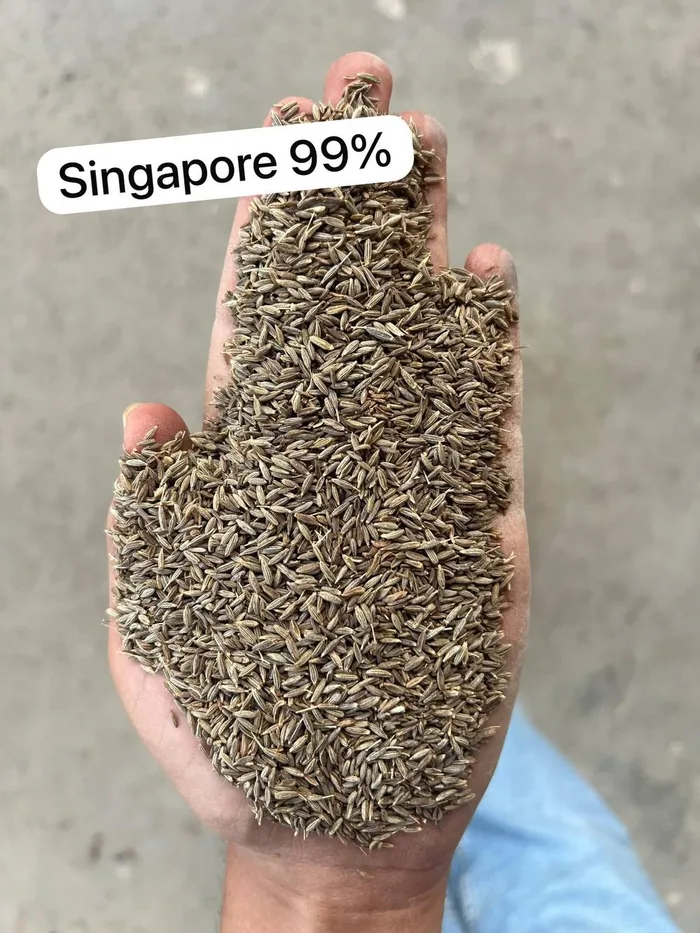
Not all cumin seeds are the same. A wholesale buyer in Dubai needs a different grade from a food manufacturer in Germany — and confusing the two can result in customs rejection, product returns, or quality complaints from end consumers.
India supplies over 70% of the world's cumin seeds, and within that, Unjha, Gujarat alone accounts for the majority of export-grade supply. But the key to successful cumin import is understanding the grade system — because "cumin seeds from India" is not a single product. It is a range of five distinct grades, each with specific purity levels, cleaning methods, and target markets.
This guide explains every grade clearly — with exact specifications, comparison tables, and a practical market guide to help you choose the right cumin grade for your business.
Key Takeaway: Singapore Grade 99% is the global benchmark for Gulf and Asian markets. Europe Quality 99.5% is required for UK, EU, Australia, and USA. Choosing the wrong grade for your market is one of the most common and costly mistakes in cumin import.
1. How Cumin Seeds Are Graded
Cumin seeds exported from India are graded based on five key parameters. Each parameter directly determines which market the grade is suitable for and what price it commands:
- Purity percentage — the proportion of pure, whole cumin seeds in a given sample, measured by physical separation. Singapore grade requires 99% minimum; Europe grade requires 99.5% minimum.
- Cleaning method — machine cleaning removes large foreign matter; sortex cleaning uses optical sensors to remove discoloured seeds, stones, and husk; double sortex passes seeds through two sortex passes for premium markets.
- Husk (admixture) percentage — the proportion of cumin seed husk or broken seeds. Ranges from 3-4% in grinding grade to 0.5% in Europe quality.
- Volatile oil content — the aromatic essential oils that give cumin its characteristic flavour. Measured as percentage by volume per weight (% v/w). Higher volatile oil = stronger aroma = better quality. Unjha cumin is known for 2.5-4%+ volatile oil — among the highest globally.
- Moisture content — cumin seeds must be below 9-10% moisture for safe international shipping. Excess moisture causes mould during transit, especially in container voyages of 15-30+ days.
Additionally, chemical parameters including aflatoxin levels, pesticide residues, ETO (Ethylene Oxide) status, and microbial load are tested at NABL-accredited laboratories for every export lot.
2. The 5 Export Grades of Indian Cumin Seeds
Here are the five grades traded internationally, from lowest to highest quality:
Moisture: Max 10%
Use: Cumin powder, masala mills
Markets: India, Egypt, domestic
Moisture: Max 10%
Cleaning: Machine + basic sortex
Markets: Saudi Arabia, Egypt, Brazil
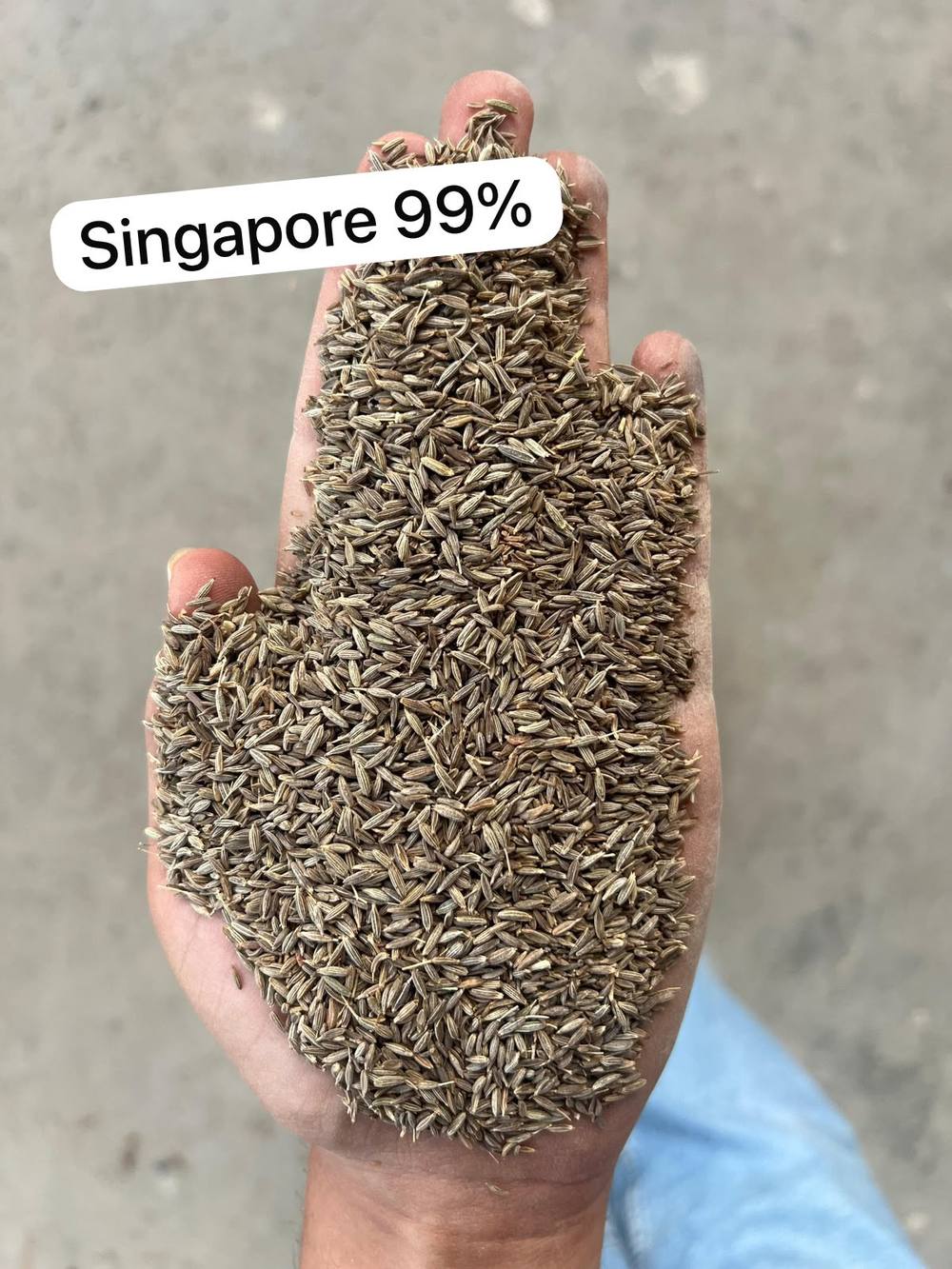
Moisture: Max 9%
Cleaning: Single Sortex
Markets: UAE, Gulf, Bangladesh, Asia
Moisture: Max 9%
Cleaning: Double Sortex
Markets: UK, EU, Australia, USA
Bold uniform seeds
Cleaning: Triple Sortex
Markets: USA premium, pharma
Specifications Table — All 5 Grades
| Parameter | Machine Clean | Gulf 98% | Singapore 99% | Europe 99.5% | ASTA Premium |
|---|---|---|---|---|---|
| Purity | 97-98% | 98-99% | 99% min | 99.5% min | 99.9% |
| Moisture | Max 10% | Max 10% | Max 9% | Max 9% | Max 8% |
| Husk/Admixture | 3-4% | 2-5% | Max 2-3% | Max 0.5-1% | Max 0.5% |
| Foreign Matter | Max 2% | Max 1.5% | Max 0.5% | Max 0.2% | Max 0.1% |
| Volatile Oil | Min 1.5% | Min 2.0% | Min 2.5% | Min 3.0% | Min 3.5% |
| Total Ash | Max 10% | Max 9.5% | Max 9.5% | Max 9.5% | Max 9% |
| Aflatoxin Total | <15 ppb | <10 ppb | <10 ppb | <5 ppb | <5 ppb |
| ETO Status | — | — | Nil | Nil (Mandatory) | Nil |
| Cleaning | Machine | Machine + basic | Single Sortex | Double Sortex | Triple Sortex |
| Packing | 25/50 KG PP | 25 KG PP | 25 KG PP | 25 KG PP | 25 KG PP |
| HS Code | 09093100 | ||||
3. Singapore 99% vs Europe 99.5% — Full Comparison
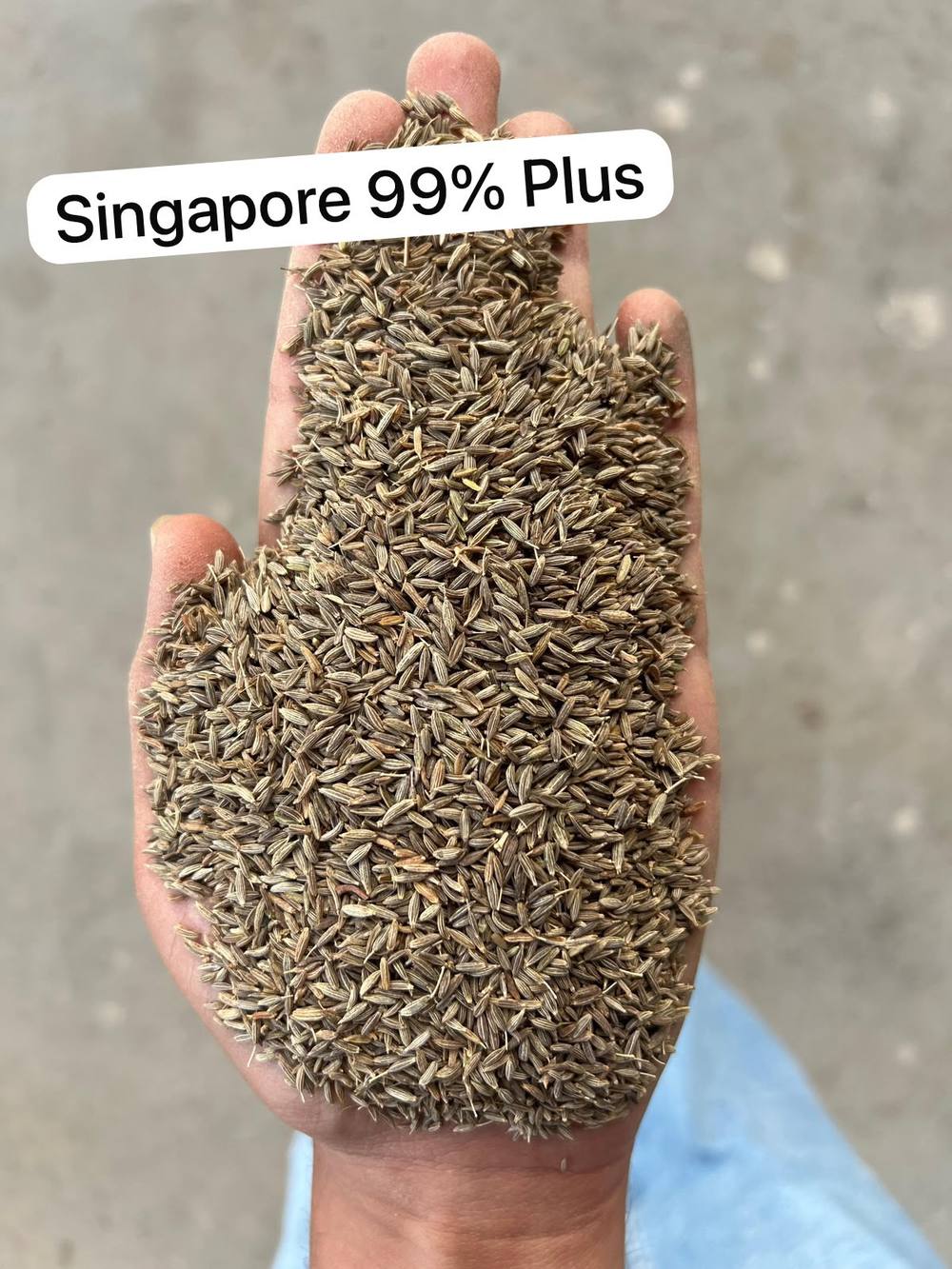
These two grades account for the vast majority of Indian cumin exports. Understanding the exact differences is critical for import buyers. Here is a complete side-by-side comparison:
| Parameter | 🟢 Singapore Grade 99% | 🔶 Europe Quality 99.5% |
|---|---|---|
| Purity | 99% minimum | 99.5% minimum |
| Cleaning method | Single Sortex | Double Sortex |
| Moisture | Maximum 9% | Maximum 9% |
| Admixture / Husk | Maximum 2-3% | Maximum 0.5-1% |
| Foreign matter | Maximum 0.5% | Maximum 0.2% |
| Volatile oil | Minimum 2.5% v/w | Minimum 3.0% v/w |
| Total ash | Maximum 9.5% | Maximum 9.5% |
| Aflatoxin (Total) | <10 ppb | <5 ppb |
| Salmonella | Absent / 25g | Absent / 25g |
| ETO status | Nil — certified | Nil — mandatory |
| Pesticide MRL | Standard Indian/Codex | EU MRL — strict compliance |
| Price vs Singapore | Base price | 8-12% premium |
| Primary markets | UAE, Gulf, Bangladesh, South Asia, SE Asia | UK, EU, Australia, USA, Canada |
| Buyer types | Wholesale traders, distributors | Retail brands, food manufacturers |
| Min order (typical) | 1 MT minimum · 13 MT (1 × 20ft FCL) standard | 1 MT minimum · 13 MT (1 × 20ft FCL) standard |
Important for EU buyers: Since 2020, the European Union has banned cumin seeds treated with Ethylene Oxide (ETO). Shipments found to contain ETO residues are recalled and destroyed at buyer's cost. Always request an ETO-free certificate and GC-MS test report for every lot shipped to EU, UK, or Australia.
4. Why Unjha Cumin Commands a Premium
Not all Indian cumin is equal. Within India, Unjha, Gujarat is recognised as the world's cumin capital — the single largest regulated cumin trading market on earth. Understanding why Unjha cumin commands a consistent premium helps buyers make better sourcing decisions.
What Makes Unjha Cumin Different
- Volatile oil content: Unjha cumin typically measures 2.5-4%+ volatile oil per lot — significantly higher than other origins. This translates directly to stronger aroma, better flavour, and higher commercial value in food processing.
- Regulated APMC market: Unjha operates under the Gujarat Agricultural Produce Market Committee (APMC) — a government-regulated market where prices are transparent and quality is graded at auction. This traceability is what international buyers and regulators value.
- Processing infrastructure: Unjha has the most advanced cumin processing infrastructure in India — sortex machines, gravity separators, colour sorters, and NABL-approved testing labs are all within the market cluster. Processing-to-port efficiency is unmatched.
- Proximity to Mundra Port: Unjha to Mundra Port is approximately 120 km — a 2-3 hour truck journey. This minimises transit time from processing to vessel loading and reduces moisture exposure risk.
Gadin Exports sources directly from Unjha APMC mandi — not from intermediary traders. Direct mandi sourcing means buyers get authentic Unjha-origin cumin, transparent procurement pricing, and the highest volatile oil content available in the market.
Unjha vs Other Origins — Quick Comparison
| Origin | Volatile Oil | Market Position | Key Markets |
|---|---|---|---|
| Unjha, Gujarat | 2.5-4%+ | Premium benchmark | Global — all markets |
| Rajasthan (Nagaur/Jodhpur) | 2.0-3.0% | Standard export | Gulf, Bangladesh |
| Syria | 1.5-2.5% | Lower grade | Regional |
| Turkey | 1.5-2.5% | Lower grade | Regional |
| Iran | 1.5-2.5% | Lower grade | Regional |
5. ETO Free Cumin Seeds — Why It Matters for Export
ETO (Ethylene Oxide) is a chemical gas that was historically used to sterilise spices and eliminate microbial contamination. In recent years, it has become one of the most critical compliance issues in the global spice trade.
Why ETO Is Now Banned in Key Markets
The European Food Safety Authority (EFSA) classified ETO as a genotoxic carcinogen — meaning it can damage DNA and potentially cause cancer. As a result:
- European Union (2020): Maximum Residue Limit (MRL) for ETO in cumin set at 0.02 mg/kg — effectively a ban. Any cumin exceeding this is rejected and destroyed.
- United Kingdom: Follows EU MRL standards post-Brexit.
- Australia: Food Standards Australia New Zealand (FSANZ) bans ETO-treated imports.
- USA: FDA has issued alerts and import bans on ETO-positive spice shipments.
How ETO Free Status Is Verified
ETO free certification requires GC-MS (Gas Chromatography-Mass Spectrometry) testing at a NABL-accredited laboratory. The test specifically measures 2-Chloroethanol (2-CE), which is the metabolite of ETO that remains in the spice after treatment. A result below the detection limit confirms ETO free status.
For buyers: Always request a NABL lab test report showing ETO / 2-Chloroethanol results for your specific lot — not a generic certificate. Gadin Exports provides SGS or Intertek NABL lab reports showing ETO status for every shipment.
6. Which Cumin Grade Should You Order?
Use this practical guide based on your market and buyer type:
🇦🇪 UAE / Gulf / Middle East
Gulf markets prefer Singapore 99% for its price-quality balance. Major wholesale markets in Jebel Ali, Khorfakkan, and Deira all trade predominantly in Singapore grade. For retail brands in UAE, consider Europe 99.5%.
🇧🇩 Bangladesh
Bangladesh is one of India's largest cumin export markets by volume. Singapore 99% is the standard grade. Buyers import through Chattogram port, predominantly via LC at Sight payment terms.
🇬🇧 United Kingdom / EU
EU and UK markets strictly require Europe 99.5% with ETO free certification and EU MRL-compliant pesticide residue levels. Retail brands and food manufacturers in Germany, Spain, Netherlands, and UK all specify this grade.
🇺🇸 USA / Canada
US FDA and ASTA (American Spice Trade Association) standards align with Europe quality parameters. ETO free is mandatory. ASTA compliance required for larger food manufacturers. Consider double sortex for premium brands.
🇦🇺 Australia
FSANZ regulations make ETO free mandatory. Australia imports through Melbourne and Sydney. Europe 99.5% with full documentation (COA, phytosanitary, fumigation) is the standard requirement.
🏭 Spice Processors / Masala Mills
Industrial buyers who grind cumin into powder or blend it into masala mixes typically source Gulf 98% or machine clean grade for cost efficiency. The grinding process eliminates visual quality concerns.
Quick Decision Guide
| Buyer Type | Recommended Grade | Key Requirement |
|---|---|---|
| Wholesale trader — Gulf/UAE | Singapore 99% | Competitive FOB price |
| Wholesale trader — Bangladesh | Singapore 99% | LC at Sight, Chattogram port |
| Retail brand — UK/EU | Europe 99.5% | ETO free + EU MRL certificate |
| Food manufacturer — USA/Canada | Europe 99.5% | ASTA compliance + ETO free |
| Spice powder manufacturer | Gulf 98% or Machine Clean | Price efficiency |
| Premium retail — global | ASTA / Extra Bold | Bold uniform seeds + low aflatoxin |
| Hotel / restaurant chain | Singapore 99% or Europe 99.5% | Consistent aroma, food safe |
7. Common Questions About Indian Cumin
Frequently Asked Questions
Everything importers and wholesale buyers commonly ask before placing their first cumin seeds order with Gadin Exports.
What is the minimum order quantity for cumin seeds export from India? +
Gadin Exports accepts a minimum order quantity (MOQ) of 1 MT for trial shipments. Standard FCL export orders are 13 MT per 20ft container or 25 MT per 40ft container. Multi-container orders are accepted subject to availability.
What is the lead time for cumin seeds export from India? +
Standard lead time is 15–21 days from confirmed order and LC opening. This includes 7–10 days for procurement, processing, and lab testing at Unjha, Gujarat, plus 5–7 days for export documentation and vessel loading at Mundra Port. Transit: Mundra to Jebel Ali (UAE) 4–6 days, to UK 18–22 days.
What documents are provided with cumin seeds export? +
Standard documentation: Commercial Invoice, Packing List, Bill of Lading, Certificate of Origin (FIEO/Chamber of Commerce), Phytosanitary Certificate (NPPO India), Fumigation Certificate, and pre-shipment COA from NABL accredited lab (SGS/Intertek) covering purity, moisture, volatile oil, aflatoxin, ETO, and pesticide residues. EU buyers also receive an EU Food Safety Compliance Self-Declaration.
What payment terms are accepted for cumin seeds export? +
We accept Irrevocable LC at Sight (UCP 600) as standard for all first shipments. For established buyers, Documents against Payment (CAD/D/P) can be discussed. Alibaba Trade Assurance is also available for buyers transacting through the Alibaba platform.
What is the HS code for cumin seeds export from India? +
Whole cumin seeds (Cuminum cyminum): 09093100. Cumin powder (ground cumin): 09093200. These codes are used on all Indian export shipping bills, commercial invoices, and certificates of origin.
How is cumin seeds purity tested before export? +
Every export lot is pre-shipment tested at a NABL accredited lab (SGS India or Intertek India). The COA covers: purity, moisture, admixture, volatile oil content, aflatoxin B1 and total (ELISA/HPLC), ETO by GC-MS, pesticide residues per EU MRL standards, and microbiological parameters including Salmonella. Each COA is lot-specific — not a generic annual certificate.
What is the difference between FOB and CIF price for cumin seeds? +
FOB Mundra — we deliver to the vessel at Mundra Port, buyer pays ocean freight and insurance. CIF — we pay freight and insurance to buyer's destination port. Ocean freight from Mundra varies: ~$15/MT to Malaysia, ~$40/MT to UAE, ~$120/MT to UK. Always confirm whether a quoted price is FOB or CIF before comparing suppliers.
Request Your Cumin Sample or Quotation
As a certified cumin seeds exporter from Unjha, Gujarat, we supply Singapore Grade 99% and Europe Quality 99.5% — NABL lab certified, ETO free, Spices Board certified. FOB Mundra and CIF worldwide. LC at Sight accepted.